Early on in private pilot training, the slip to landing seemed to be a daunting task. Setting up a slip and then, in a controlled and coordinated way, taking the cross control out and transitioning to a normal landing just over the runway seemed like a difficult challenge. However, as I’ve gotten better at handling crosswind landings and the gusts that occur, the skills to handle the forward slip have developed as well. Today was a day I spent working out that skill set.
We went through the pattern as normal, except that I kept power and altitude up going into the final leg in order to intentionally come in too high. The runway was 160 and winds were between 4 and 7 knots coming mainly from the East. The slip is fairly straight forward: wing into the wind and full rudder. One change is that we did this with no flaps. While the Cessna 172 SP can handle slips up to 20° of flaps (the POH mentions that in certain conditions a buffet can occur with full flaps), we did this with no flaps in order to get down faster. I suppose one of the differences here is that during the side slip to account for crosswind, the amount of rudder necessary is to keep the centerline and the aileron is to counteract the wind; in the forward slip it is full rudder to present the side of the aircraft to the oncoming air and the ailerons are used to control the direction of the descent. Once the “good glideslope” sight picture is established, the cross-control is removed.
During this forward slip the speed is kept pretty high. My instructor told me to keep it between 70 and 80 knots. One error I made early one when transitioning back to normal landing is to pick up the nose to slow down. Of course, this causes a balloon which negates the slip that had occurred up to this point. The correction here is to keep the nose down and use the flaps to help slow the plane. With each notch of flaps the nose will want to come up, so it’s a series of progressive nose-down pressures with each.
Getting out of the slip takes a bit of practice, but much like practicing stalls, with each run through, confidence builds and it can be done more rapidly. At first it was difficult to get from 80 knots to 65 knots on short final, but with a more rapid flap deployment, the landings became better and better.
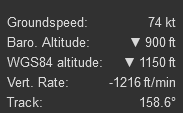
Looking back on the ADS-B data for the flight, quite a lot of altitude can be shed in a short span of time. While this wasn’t a particularly aggressive attempt to lose altitude, we still managed a descent rate in excess of 1200 ft/min.

