A couple of lessons in during a takeoff my instructor told me that it would impress my examiner down the road if instead of rolling while applying power I should instead hold the brakes to 2000 RPM, check the gauges, smoothly release the brakes, and then go to full throttle. So for the next several takeoffs that is what I began doing. I had assumed that this was to ensure that very minimum takeoff power was achieved for safety, and it also gives another chance to check the fuel and oil gauges before takeoff in case things go wrong. Of course, I’ve pondered why do this, and finally curiosity and a free minute coincided. Apparently, this practice will lower the takeoff distance by as much as 500 ft depending on the airplane. Apparently there is some debate about this practice (what a shock, right?) and some say that you can achieve the same results by performing a rolling start from the taxiway.
During one of my first introductions to single engine aviation a pilot demonstrated a short-field takeoff for me. Brakes were held until full throttle and with flaps and we leapt off the ground. So at least for short-field takeoff, when distance is precious, this practice trumps even the rolling start.
I read that the “book” take-off charts and tables were generally written with a brake-release takeoff. This got me curious so I went and found the POH for the Archer II that I’ve been learning in. Sure enough, right at the top of the chart, “FULL THROTTLE BEFORE BRAKE RELEASE.” There are no charts for the rolling start. This is a very good tip I’m going to have to remember explicitly. Pre-flight involves using these charts to ensure that there is enough runway to takeoff and this is a pretty important detail in all of that planning. If a rolling take-off is to be attempted then extra runway needs to be accounted for.
The check-list we’re using has a takeoff power of 2325 RPM. If I’m going to full power in around 3 seconds to 2700 RPM, takeoff power isn’t going to be reached until a little over two seconds in. That far in I’m already multi-tasking the rudder, staying on the center line, checking the airspeed, looking for obstacles, and waiting for 60 KIAS to lift off, and of course checking the power to reach 2325 RPM. If we start at 2000 RPM and the plane doesn’t achieve minimum climb power of 2325 then we haven’t gone very far by the time a problem so there is a lot of runway left to manage the situation. Plus we aren’t moving very fast yet.
So it seems the best practice really is to hold the brake before taking off, even if one occupies the runway a few seconds longer.
Not long into my flying I mentioned to my CFI that had gone pretty far into my ground studies long before I started flying with him. A lot had fallen out of my head apparently. When he asked me about induced drag I got my terms mixed up and confused it at first with parasitic drag (thinking it was the drag caused, i.e. induced, by the speed of the aircraft, then wondering if it was the drag caused [induced] by the form of the aircraft. Nope, forgetful me, it is the rearward component of lift. More specifically, induced drag is the component of life acting parallel to the free-stream airflow.
All is fine until I got to this topic in the Sporty’s flight training. I was expecting as simple a definition that I had come across, but it said something that seemed odd. “The wingtip vortex… is the source of induced drag and is not the same as the downwash needed to produce lift.” But wait, if the air is being deflected downward, i.e. downwash, by the creation of lift, then the relative wind is not horizontal (in straight and level flight) but at an angle, and the lift vector is pointed rearward, so there is a horizontal component to that vector and it is induced drag, right? When I go look up the definition of induced drag I get simply this: “Induced drag is the inevitable consequence of lift.” That sentence is actually alarmingly unhelpful when trying to understand just what is going on, but it directly contradicts Sporty’s definition of induced drag. Sporty’s would seem to suggest that if there is no wingtip vortex, then there is no induced drag.
Now contrast this with Wikipedia’s caption of the free body diagram. “Induced drag is related to the amount of induced downwash in the vicinity of the wing.” Right away this contradicts Sproty’s definition. Wikipedia goes on to say that the resulting downwash in the vicinity of the wing results in an effective relative airflow in a different direction than the relative free-stream airflow. So your plane is flying along in straight and level flight (with some kind of angle of attack), the relative wind is coming straight towards the airplane. However, in the vicinity of the wing the relative wind is has an induced downwash. Meanwhile the lift vector of the wing is not straight up, opposing gravity, but rather, tilted backward by the same angle between the wind near the wind and the free-stream wind. The cosine of that angle multiplied by the lift force is the induced drag force.
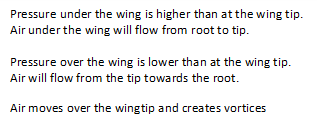
Wikipedia does go on to explain the reason for wingtip vortices. There is a span-wise airflow from the lower surface wing root around the wingtip back towards the upper surface wing root. This span-wise flow combines with the chord-wise flow to create vortices. The vortices are what cause the down-wash. So I’m very suspicious of Sporty’s explanation, “induced drag is not the same as downwash needed to produce lift.” Right away I have to wonder, does that mean that downwash is more pronounced at the wing tips than the wing root if the downwash is indeed induced by the vortex since the vortex would not expand all the way along the wing. Looking at the rather simplistic explanation at NASA’s website this appears to be the case. Also this article agrees with the Wikipedia article. The part that is easy to miss though is that the wingtip vortices cause an additional downwash, not all of it.
One way to explain this is Newton’s Third Law. The downward flow of the air is the equal and opposite reaction to the lifting force. So then, what were to happen if the wing were infinitely long, or if one were to totally fence off the wingtip so that there could be no spill over the wingtip, back to Wikipedia on this one: “…a wing of infinite aspect ratio and constant airfoil section would produce no induced drag. The characteristics of such a wing can be measured on a section of wing spanning the width of a wind tunnel.” So does that mean an infinitely long wing generates no lift? Is there no downwash for such a wing? Back to being confused?
MIT has lecture notes relating to this particular topic. “There is a non-zero downwash velocity -w at the wing itself (w is positive up). In other words, the wing operates in its own downwash. The apparent freestream velocity which the wing sees (compared to the airplane) is therefore tilted by the induced angle αi . The effective angle of attack that the 3-D wing sees is significantly reduced from the geometric angle of attack α; αeff = α – αi Because αeff < α, the lift generated be the 3-D wing is less than if the downwash and induced angle were absent, as in the 2-D case. In practice, this means that the 3-D wing has to operate at a greater geometric α to achieve the same lift/span as the 2-D wing.”
Maybe all of this is academic since there is no such thing as a 2-D wing. It is interesting though that there is in fact an apparent updraft ahead of the 3-D wing and downwash behind it. It is this 3-D wing that generates vortices. Induced drag is the effect of the 3-dimensional flow of air as lift is generated. I think I’m starting to get this. In the end, what was listed in the Sporty’s course seems to disagree with everything else I’ve read on the subject. Vortices make induced lift worse, but the downwash created by the 3-D wing is necessary to generate lift, and the by product of generating lift is both induced drag and downwash – penalties that simply cannot be separated, but they can be minimized.
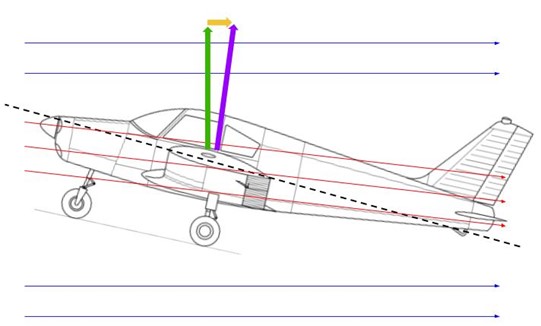
For our airplane in straight and level flight, the blue arrows represent the free-stream air not affected by the wings. The red arrows represent the flow of air deflected downward by the creation of lift. The effective lift, purple arrow, has two components, the upward component opposing gravity (green) and the induced drag component (yellow). This vector picture is with respect to the airplane, not the wing alone – the wing actis in its own downwash – the air near the wing is at a different direction than the broader free-stream air. The angle of attack of the wing is between the chord line and the red arrows, not the blue. Of course, I’ve exaggerated the downwash quite a bit, and the difference is actually not all that large.
If you want to geek out on this as much as I did, here are a bunch of things that came up in my search. If not, then just remember that induced drag is the yellow arrow!
Training so far has been a little haphazard with regard to what to study. I have been reading the ASA Student Pilot Flight Manual for quite some time. Not long ago I bought a Sporty’s Pilot Training Online course and I’ve been going through the videos. Fairly recently my instructor sent me his syllabus. So I’m going to log what I’ve been studying today for first lesson in the syllabus he sent me. I’ll probably call these “Syllabus” vs “Sporty’s” vs “AOPA.” I’ve got a huge number of books so far, and a lot of notes and studying to do in them…probably too many of them.
So to start, I’ll go through the questions to be answered in the first lesson.
Why is a thorough preflight inspection important? To determine if the airplane is in a condition that is safe to fly.
What would you do if you noticed that the tail hook was missing during the preflight inspection? Deem the aircraft is not airworthy and not safe to fly. In order to be airworthy, it must be in a safe condition, and it must conform to the type certificate and authorized modifications. If the tail hook is missing it is a sign that the airplane might be damaged; a missing tail hook, or any missing part that was present when the airplane left the factory floor, does not conform to the type certificate and is thus also not airworthy.
As you take the runway what should you do with your HDG indicator? Check/adjust to ensure that it aligns with the runway heading.
How can we determine the wind direction while walking out to the airplane? Check the wind sock, trapezoid, or wind-T. You can also look for flags, nearby smoke/steam, water, trees, etc…
Why is wind speed and direction important? Wind direction is important to know which runway will be used at the airport. Wind speed and direction are important to calculate the necessary runway to take off and roll-out on landing.
How should the ailerons be positioned during taxi? “Turn into the wind, dive away from the wind.” Headwind turn the yoke towards the wind; tailwind turn the yoke away.
Why do we check the brakes immediately after the aircraft begins to move? To ensure that the brakes are effective before we begin to taxi and that they will be effective during run-up. If they are not effective immediately shut down the engine.
Is it safe to fly if you found a large puddle of red fluid under the brakes? No, red fluid is brake line fluid and the puddle signifies that there is likely a leak that will make the airplane unsafe.
What color is 100LL fuel? 100LL is blue in color.
What would you do if you saw water in the fuel you strained? Continue straining the fuel until all of the water is removed from the tank. Tap the tank and rock the airplane and continue to strain until there is no water for a few strains consistently. Repeat this for both tanks and the fuel sump.
How much oil should be in the sump? For the Archer II there should be 6 to 8 qts.
Should you fly with a large flat spot on one of the tires? No, the plane is not airworthy with a flat spot on the tire.
Which control surfaces does the yoke move? The ailerons and elevators.
Which controls steer the airplane on the ground? The rudder pedals and brake pedals.
Where should the pilot keep their right hand during taxi? On the throttle.
Name the three axes about which the aircraft moves. Yaw (vertical), roll (longitudinal), and pitch (lateral).
The elevator controls: pitch
The rudder controls: yaw
The ailerons control: roll
Name to ways we can change speed in flight. Pitch and power.
Does the plane stop flying if the engine stops? No, the plane will continue to fly without the engine – it will glide.
How do we manually move an airplane on the ground to reposition before start? With a tow bar. Never move an airplane by the propeller or hub.
Can we push on the propeller spinner? No, it can damage or dislodge the spinner or damage the hub.
Rereading the AFH (Airplane Flying Handbook) chapters 2 and 3 was a refresher. I haven’t read very far into PHAK (Pilot’s Handbook of Aeronautical Knowledge) so I’ll have to take a look at chapters 1 and 14.
Other links I have to get downloaded, and I’ll probably load onto my Kindle are:
Oh and some other tidbits I picked up doing the AOPA quiz:
For Hire means carrying people or property for compensation. Flying your own airplane or renting an airplane for just yourself is not for-hire.
AROW: Airworthiness certificate, Registration certificate, Operating limitations, Weight and balance. These need to be on the airplane at all times.
You should smell and feel the fuel you strain. Jet fuel will feel oily and smell like kerosene. It’s not just looking for color and sediment.
Tire pressure drops with temperature: 10ºF = 1 psi at normal atmospheric conditions. This is important for tire pressure during preflight.
The pilot in command, PIC, is responsible for ensuring the aircraft is safe. When you’re the student, that would be your CFI.
Do not blow into a blocked pitot tube. You could lodge whatever is blocking the tube further inside. Also, it’s pretty funny to imagine someone burning their lips on a warmed pitot.
Windshield should be cleaned with water and a soft cloth. Plexiglass cleaner is fine. But do not use Windex or it will fog the plexiglass. Paper towels will scratch the windshield. Shop rags can contain oil and contaminants that could damage the windshield or obscure it.
That was the weather report when I was supposed to have my fifth lesson. Unfortunately, the schedule is full tomorrow so lesson five is going to have to be next weekend. I already had a 2-hour lesson scheduled for next Saturday, but I put in a 3-hour lesson on Sunday to make up for this week. In the meantime it’s back to reading the FAR/AIM, watching the Sporty’s Pilot Store flight training videos I bought as my ground school guide, and reading the Pilot’s Handbook of Aeronautical Knowledge. A lot of what I’m reading is really a review of things I already know, but I am not to the point of being able to recite this knowledge accurately on a moment’s notice, so I keep re-re-reading. My CFI mentioned that he built a PowerPoint to summarize the knowledge he learned. I think part of this blog is going to be a recording of lessons. Maybe someday I’ll publish it all in a nice, clean presentation that I can host here.
I’m having a very hard time not fantasizing about having my own plane. I heard the Cessna 177 is rather spacious inside and economical to fly. But then, I also fantasize about building a Sling TSi. It takes a lot of reminding myself, first get the license, then get rich, then worry about owning an airplane. Instead I turn my mind to the fantasy of flying off to someplace for the fun of it. I can’t wait to be back up in the air, terrifying myself with landings and stalls again!


 FencerPTS